"Staff has reviewed the request by the homeowners and found that it does meet the minimum eligibility requirements for the H and I Z program."
That sentence, read into the record at a January 2026 meeting of McKinney's Historic Preservation Advisory Board, doesn't sound like anything a home buyer needs to care about. It's the kind of line that gets buried in city meeting minutes and never makes it into a listing description. But if you're comparing a historic home near the McKinney square against a similarly priced resale in a newer part of town, that sentence might explain a gap on the tax line that a mortgage calculator can't.
Here's the part most buyers miss: McKinney's Historic Neighborhood Improvement Zone program doesn't just knock a few dollars off a homeowner's bill while they own the house. It creates a status the property carries, one that can pass to whoever buys it next, and one that comes with maintenance obligations most people don't discover until after they've closed.
What the Program Actually Does
The HNIZ was built to encourage owners inside McKinney's historic boundary to maintain and rehabilitate their homes rather than let them slide into disrepair or get torn down. In exchange for documented investment in a property, the city exempts part or all of the home's value from city ad valorem taxes for a fixed period.
The program runs in tiers, and the tier determines both the size of the break and how long it lasts.
| Level | Exemption | Duration | Minimum Age | Minimum Investment |
|---|---|---|---|---|
| Level 1 | 100% (one-time) | One-time | 50 years | $10,000 |
| Level 2 | 50% | 10 years | 40 years | $10,000 |
| Level 3 | Larger rehabilitation tier | 10 years | 40 years | Higher threshold |
A slate of eight properties approved by the board in January 2026 carried exemptions ranging from 30% to 100%, with the city estimating roughly $314,469 in ad valorem revenue foregone from that group alone. The program has an annual citywide cap of $500,000, and as of a November 2025 meeting the running commitment sat around $298,344, comfortably inside that ceiling.
Those aren't abstract numbers. They're the reason a downtown home with a below-market tax bill isn't necessarily a data error on the listing sheet.
The 1960s Ranch on Brook Lane Qualifies the Same as the Queen Anne on College Street
Most people picture gingerbread trim and wraparound porches when they hear "historic tax exemption." The age threshold tells a different story. Level 2 and Level 3 only require a home to be 40 years old, not a 19th century landmark.
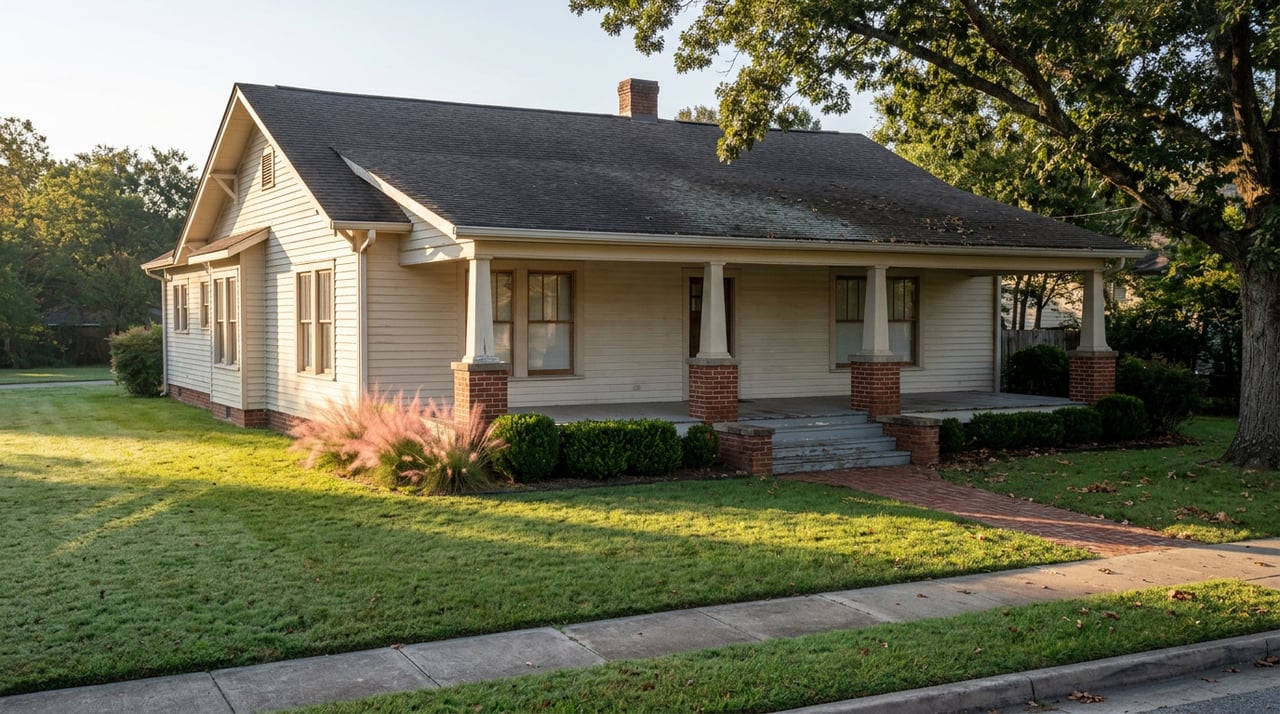
That's why, at a March 2026 board meeting, the exemption request that went through wasn't for a Victorian near the square. It was for 408 Brook Lane, a ranch-style house built around 1960, owned by Michael Curran. The eligible work was a furnace, electrical repairs, wiring, and sewer and plumbing fixes, totaling just over $11,000, comfortably clearing the $10,000 minimum. There was a timing inconsistency in the paperwork that staff flagged, and the board approved it anyway because the underlying investment met the threshold.
Compare that to two properties approved the previous November: 505 North College Street, a Queen Anne built around 1895, where a $23,750 HVAC replacement qualified for Level 2, and 705 North College Street, a Classical Revival from around 1905, where $41,419 in trim replacement, foundation re-leveling, crawlspace duct work, drainage improvements, and window replacement cleared the same tier.
Notice what all three projects have in common. HVAC, electrical, plumbing, foundation work. These are the exact line items a home inspector flags on a pre-1990s McKinney property, the same categories inspectors in this market routinely call out on pier-and-beam foundations and original wiring. The program isn't rewarding cosmetic staging. It's subsidizing the unglamorous systems work that buyers and sellers already have to budget for, provided it gets done through the right process.
The Exemption Follows the House, Not the Person Who Earned It
Here's the mechanism that changes how you should read a listing. According to the city's own guidance, a current HNIZ exemption is transferable upon sale of the property. The new owner doesn't have to reapply from scratch or lose the benefit at closing.
There's a catch worth sitting with. You can't stack a second exemption on top of an existing one. If you're approved for a new incentive, it replaces whatever was already in place rather than adding to it. So if you buy a home mid-way through someone else's 10-year Level 2 clock and later do your own qualifying rehab, you're not layering a second discount, you're resetting the one that's already running.
This means the tax line on a downtown listing sheet could represent a benefit that survives the transaction, but only if it's still active and only if you understand which clock you're inheriting.
What Keeps It Alive After You Close
A transferable exemption isn't a set-it-and-forget-it discount. The city treats it as an ongoing commitment, not a one-time reward.
Three things happen every year that a buyer stepping into an existing exemption needs to know about:
- The property must be reapplied for with the Collin Central Appraisal District annually, and the city's own reminder sets that deadline at April 1, a full month ahead of the general property tax exemption deadline most Collin County homeowners are used to.
- The Historic Preservation Office conducts a visual inspection every January to confirm the property is still being maintained in keeping with the program's intent.
- If the office finds the property has fallen into disrepair, the owner gets written notice and one year to fix the deficiencies. If they aren't cured in that window, City Council can suspend the incentive.
That April 1 date is the trap. Most new homeowners in Collin County have April 30 in their head as the property tax exemption deadline, because that's the general filing date for homestead and other standard exemptions through Collin CAD. HNIZ runs on its own earlier calendar, and missing it by even a few weeks can mean losing the exemption for that tax year, not because the home stopped qualifying, but because nobody flagged the different deadline in time.
The Certificate of Appropriateness Is the Other Half of the Bargain
If you're drawn to a historic downtown home because you plan to update it, there's a second process that runs alongside HNIZ. Any exterior change visible from the public right of way, additions, new siding, window replacement, even some fence work, requires a Certificate of Appropriateness before a building permit gets issued.
Ordinary maintenance and in-kind replacement, like swapping cedar shingles for matching cedar shingles, doesn't trigger the requirement. But anything that changes the material or design does. Complete applications typically take 10 to 30 days for staff review, and if a request needs to go in front of the full board rather than being handled at the staff level, it has to be submitted at least two weeks ahead of the board's monthly meeting.
That timeline matters if you're under contract with renovation plans baked into your budget. A buyer who assumes they can start demo the week after closing may find themselves waiting on a board decision instead.
What This Means If You're Comparing Two Listings This Fall
Downtown McKinney listings were carrying a median price in the high $400,000s as of mid-2026, with individual historic-district properties ranging anywhere from the $300,000s to $900,000 and up depending on size and condition. When two homes in that range sit side by side with meaningfully different tax lines, the gap is worth investigating rather than assuming.
Before writing an offer on a historic-adjacent property, it's worth asking the listing agent three direct questions. Is there a current HNIZ exemption on the property, and if so, which level and when does it expire. Has the annual reapplication with Collin Central Appraisal District been filed on schedule. And has the Historic Preservation Office's most recent January inspection turned up any deficiencies that could put the exemption at risk.
Those answers won't show up on a standard listing sheet, and they can be the difference between a home whose tax advantage carries forward for years and one where the buyer inherits a countdown that's already closer to zero than it looks.
Frequently Asked Questions
Does every historic-looking home in downtown McKinney qualify for HNIZ? No. Eligibility depends on the property's age, location inside the defined HNIZ boundary, and documented qualifying investment, not on architectural style alone. A 1960s ranch can qualify under Level 2 if it clears the 40-year threshold and the $10,000 investment minimum.
If I buy a home with an active exemption, do I need to do anything to keep it? Yes. The exemption transfers, but it isn't automatic maintenance-free. You'll need to keep up with the annual reapplication through Collin Central Appraisal District and maintain the property to the standard the Historic Preservation Office checks each January.
Do I need a Certificate of Appropriateness for interior renovations? Generally no. The COA process applies to exterior changes visible from the public right of way. Interior work typically falls outside that requirement, though it's worth confirming with the Historic Preservation Office before starting any project that touches both.
Is historic designation something a seller has to disclose? Yes. Historic designation and any related restrictions are the kind of material fact that belongs on the seller's disclosure and should be confirmed through the title process before closing.
If you're weighing a historic downtown McKinney property against new construction or a resale in one of the master-planned communities, the tax line is only one piece of a comparison that includes renovation timelines, inspection findings, and what a Certificate of Appropriateness might mean for your plans. Deborah Diviney has spent years walking McKinney buyers through exactly this kind of side-by-side. Schedule a free home valuation and consultation to see what a specific historic-district property's tax history and rehabilitation options actually look like before you write an offer.
